



Your baby is perfect. If you could go back in time, to before your little one was born, and choose between your baby and some other hypothetical infant, you’d choose your baby every time.
What if the question arose before you ever saw your baby for the first time, before you felt a kick, before the first ultrasound? What if you were asked to choose between embryos, with advance information on traits like height, intelligence, eye color, and the likelihood of ADHD, OCD, and anxiety disorders?
Now, a company is offering exactly that, and raising concerns about the line between wanting the best for our babies and eugenics.
Exactly What Is Being Offered?

This isn’t DNA editing. It’s embryo selection, based on DNA analysis, and it’s coming from companies like Nucleus Genomics, specifically targeting parents who are using IVF.
IFV can be a complicated and expensive process, and generally involves creating multiple embryos. Then, a doctor transfers one or more that seem viable into the uterus, and then everyone waits anxiously with the hope that there will be a successful pregnancy. Sometimes, embryos are selected for their sex chromosomes, but that’s already a bit controversial.
Nucleus Genomics is offering to go beyond that line. They will analyze the embryos’ DNA and give the parents a profile of the traits they can expect. In a press release earlier this year, the company says the focus is on heritable health conditions.
“Now, advanced genetic analysis from Nucleus gives parents a new window into the health and well-being of their future child. Nucleus Embryo provides a comprehensive genetic profile for each embryo, encompassing hereditary genetic diseases, like cystic fibrosis and hemochromatosis, alongside genetic measures of cognitive ability, mental health, and risk for chronic diseases.”
IVF is expensive, and current genetic screening is intended to increase the likelihood of a successful pregnancy and healthy baby — but this kind of DNA analysis seems to amp that up considerably.
The Program Doesn’t Stop At Health Conditions, Though
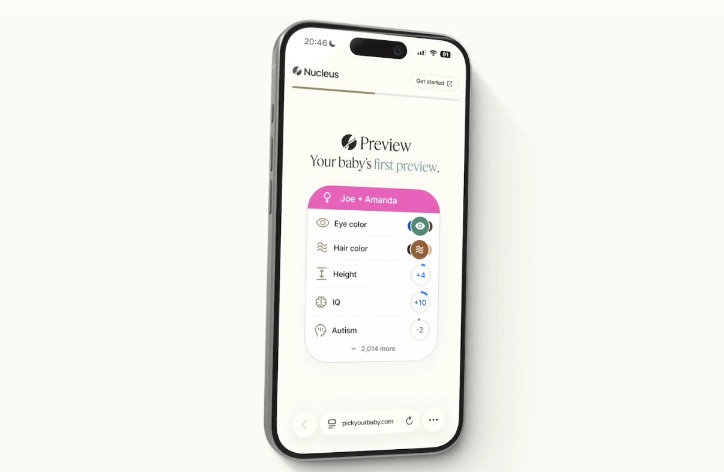
While the press release focuses on health conditions, Nucleus Genomics’ website lists eye color, hair color, and left-handedness as additional traits that can be identified for each embryo. In one image, a phone screen is shown listing traits, including IQ and autism.
Other conditions and traits mentioned on the website include restless legs syndrome, BMI, male pattern baldness, alcohol dependence, OCD, depression, anxiety, and severe acne.
If this is starting to sound like it skates close to eugenics, you’re not alone. Orchid, another company offering the same service, caught attention earlier this year, in part because of its connection to Elon Musk, after the mother of four of his children was reported to have used it.
At that time, the Washington Post reported that Jonathan Anomaly, a bioethicist associated with Orchid, dismissed the term “eugenics” and said he preferred “genetic enhancement.”
An investor associated with the company also downplayed the idea of eugenics.
Delian Asparouhov, a partner at Thiel’s Founders Fund who has invested in Nucleus, made a similar argument. “When you choose your married partner, you’re using a form of eugenics,” he said. “When your kids are older, you invest in tutors and great schools. What’s the harm in using a tool that allows you to amplify that type of effect?”
However, there’s a wide line ethically between choosing to have a baby with a partner whose traits you adore, and picking and choosing which genes your embryo will have.
How Effective Is This Gene Selection, Anyway?
There are plenty of ethical concerns when we consider screening embryos to prevent birthing an autistic child, a right-handed kid, or a boy who will grow up to be a customer for hair regrowth services.
However, another question is whether it even works.
The question of “nature vs nurture” is ages-old, and to the extent we have answers to it, the answer is usually “some of each.” That is, most traits we think of, like height, BMI, intelligence, and yes, potentially even traits like autism and ADHD, may have a genetic predisposition, but are influenced by environmental factors.
Also, for traits like autism and ADHD, we have strong evidence of heritability, but haven’t identified or isolated the genes that result in them, so any promise of identifying those traits depends on finding groups of genes that are common to people diagnosed with those disorders, and making an assessment of the likelihood. In fact, according to Genetics & Society, the American College of Medical Genetics and Genomics (ACMG) is actively advocating against the use of polygenic risk scores for embryonic selection.
“However, even with the most sophisticated technologies available, genetic studies on complex traits and disease constitute an inexact science and do not identify affected individuals as does testing for monogenic disorders. Rather, it only assesses the risk for developing a disorder. … the ACMG is of the opinion that prenatal testing for disorders that exhibit multigenic or polygenic inheritance is not yet appropriate for clinical use and should not be offered as direct-to-consumer testing.”
So, What Should Prospective Parents Consider?
Do talk to your doctor about the screening that is offered. They can screen out conditions that make it less likely your embryo makes it through pregnancy, and you can make informed decisions about other heritable conditions.
However, plunking down the money (tens of thousands of dollars in addition to the costs of your IVF process) for additional genetic analysis is probably not in the best interests of most parents.
If you’re thinking about it, you should discuss with a trusted doctor the conditions you’d like to screen for and get honest answers about whether they can even be identified by genetic testing. Consider carefully what you’re screening for and why, and discuss with your partner.
Ultimately, make sure that you are making a decision that fits with your values and is scientifically sound before moving forward.