



Yesterday, my five-year-old shouted at me, “Mom! Santa is not real!”
My heart froze for just a moment before I realized that she specifically meant a Santa decoration on someone’s roof. That Santa was made of lights and wire, and he certainly was not real.
Still, the moment reminded me that it probably won’t be too long before she comes to me with big questions about Christmas. Even though I’ve had this conversation before, with her older siblings, it’s still a very emotional experience, and a little scary to face.
Still, when she finds out, it doesn’t mean the end of Christmas magic. It just means a shift to a different kind of magic.
When Do Kids Give Up Believing In Santa?
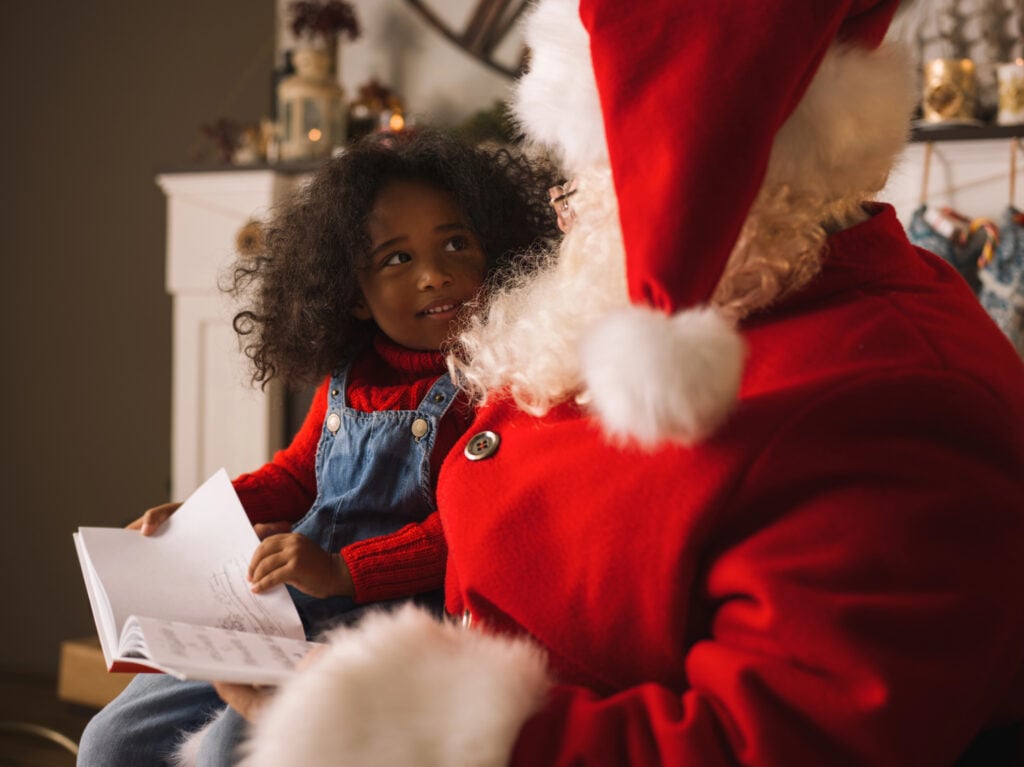
Do you remember the moment you started to question whether Santa Claus was a real, genuine, magical being who really could deliver millions of toys to children all over the world in a single night, using his flying team of reindeer?
It marks a change in a child’s view of the world, a moment when that child begins to see things with greater skepticism. It’s a moment of loss and growth, and parents can shape it into a moment of connection and sharing.
A YouGov poll in 2022 asked adults when they stopped believing in Santa, and the answers are spread out, with a few reporting that they found out as early as age 4 (1%) or 5 (5%) years old, and the majority say they learned between the ages of 6 and 10. Specifically: 8% at age 6; 10% at age 7; 10% at age 8; 7% at age 9; 9% at age 10; about a quarter aren’t sure, and 14% said they never believed.
About 41% say they figured it out themselves, and only 12% say that a parent told them. Another 12% credit a sibling with passing down the information, and 10% say they learned from a friend.
The takeaway from this: your kids are likely to figure it out on their own, but if you want to be the one to break the news, you may need to be diligent in monitoring what information they’re getting from others.
What Happens When Kids Stop Believing?
A small percentage of kids have strongly negative reactions when they lose belief in Santa.
Some will feel betrayed, and some will question other things their parents have taught them, including other vital entities they’ve been taught about, like the Easter Bunny and the Tooth Fairy. Some kids will even question important figures in their faith traditions, so parents need to plan how they’ll handle this.
When polled, about half of adults remembered being “very disappointed” (20%) or “somewhat disappointed” (30%) upon learning about Santa, and just over a quarter (27%) say that one effect of the Santa tradition is “feelings of mistrust and disappointment” when the belief comes to an end.
Researchers in another study spoke to families with children who no longer believe in Santa, and found that 21% said they trusted their parents less after learning the truth, according to Psychology Today. A majority said it hadn’t changed how they trusted their parents, and most negative feelings were relatively short-lived.
In summing up finding out the truth, one young boy in the study told his parent that while he was sad and disappointed that “the magic wasn’t real, he was amazed that the ‘whole world’ was able to keep this secret going, and he fell for it.”
How Can Parents Ease This Transition?
We all hope that our kids will be among the ones who respond to the news by happily transitioning from believers to participants, and parents can help with this.
First, watch your child for signs of doubt, and have a plan for honest answers. Pressuring your child to continue believing, or pretending to, can create resentment when they have questions. (This doesn’t mean they should shout it from the rooftops. It just means they shouldn’t have to fake it for adults’ comfort.)
Then, follow your child’s lead. When they ask if Santa is real, ask what they think, and let them lead the conversation. Many parents find that explaining Santa as a tradition and a game can help, and kids who no longer believe may be happy to continue participating in the tradition.
Discuss Santa in the context of a tradition and a metaphor for the spirit of giving, not a “trick” that has been played, and encourage your children to join in with the adults as part of the fun. Help them understand that it’s now their role to pass the tradition along, and not to spoil it for younger kids.